
Recently we have been asked about the progress Public Services and Procurement Canada (PSPC) has made towards disposing of properties it has identified as surplus in the Ottawa area. The following is an attempt to answer that “simple” question.
This generally leads to a much larger discussion about how much office space will the Government of Canada need for its operations in Ottawa. That in turn leads to the heart of what folks really want to know – how much (OF MY) office space will PSPC want to lease/keep leasing?
The magic three-part answer is as follows:
- It’s hard to tell.
- It’s about the same as always.
- Don’t ignore the other stuff going on.
It’s hard to tell
It is hard to tell how PSPC is making out in selling these properties in part because it is hard to know where to look to find the answer. In this little article, we will reference the Government of Canada, Public Services and Procurement Canada, Treasury Board Secretariat, Auditor General of Canada, Canada Lands Corporation and Canada Mortgage and Housing Corporation websites.
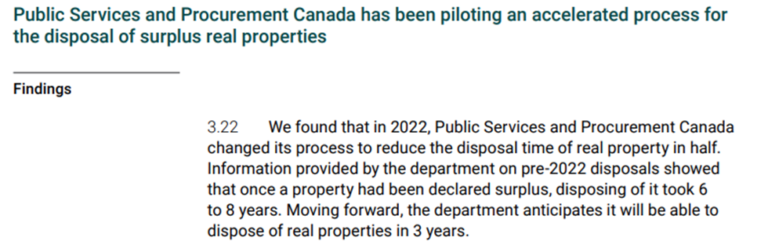
The Auditor General in its June 2025 report of the Current and Future Use of Office Space report had much the same experience in attempting to sort out just this – how is PSPC doing disposing surplus properties?
They commented in part as follows:

It is hard to tell how PSPC is doing in part because their disposition cycle is long, involved, opaque and convoluted.
To help understand a process that used to take 6-8 years may be reduced to 3 years, check out this chart outlining the process of sourcing sites for affordable housing – the Federal Lands Initiative. It captures much of that process (from a Canada Mortgage and Housing perspective) as illustrated in that Auditor General of Canada report.
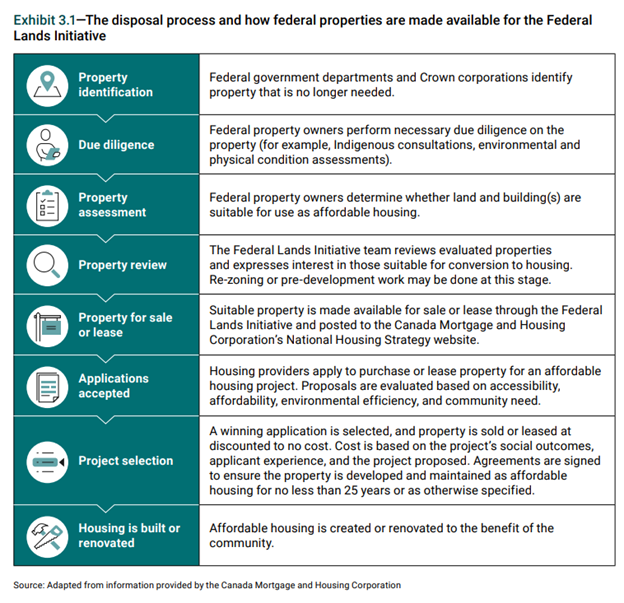
For surplus property in general, the protocol includes:
- Consult with Justice, Indigenous Services, Crown-Indigenous Relations and Northern Affairs Canada.
- Notify and consult with Canada Lands Corporation (CLC) for appropriate market management given the property’s scale, if value can be added by redevelopment, if there could be other organizations with which to partner to add value, and if sensitive policy issues exist.
- Collect expressions of public purpose interest in any or all the sites from federal departments, agent Crown corporations, provinces, municipalities and Indigenous groups.
- Granting authority to acquire, if CLC does not undertake the site, to federal departments, agent Crown corporations, provinces, municipalities and Indigenous groups in that order.
- Ensure identified public purpose interests and an expectation to reasonably address them if feasible are included in agreements with CLC.
- Develop a business case for the disposal of this surplus site.
- Remediate the site or take action to manage the risks associated with contamination before disposal, requiring the acquiring party to remediate after the sale, and ensure the legal transfer of environmental liability to the acquiring party.
- Transfer the administration of the site to other federal departments and exchanging funds between departments at no greater than market value as per the Mandatory Procedures for Appraisals and Estimates; and
- Justify the amount paid for transfers of administration to agent Crown corporations, and sales of real property in relation to market value as above.
There is also a requirement to meet the Mandatory Procedures for Reporting and that includes reporting information to the Directory of Federal Real Property, the Federal Contaminated Sites Inventory and the Centre for Government Greening. Lastly, the Standard on Due Diligence identifies all the due diligence activities to be undertaken disposing of or transferring administration of real property.
What is reported in the press is what is put on the surplus list. That happens very early in this process. The process for selling the property begins after CLC has completed its value-add exercises and decontamination is completed. This gap can be years. For example, Tunney’s Pasture took 12 years to get an approved redevelopment plan.
It’s about the same as always
Once again, from the Auditor General report:

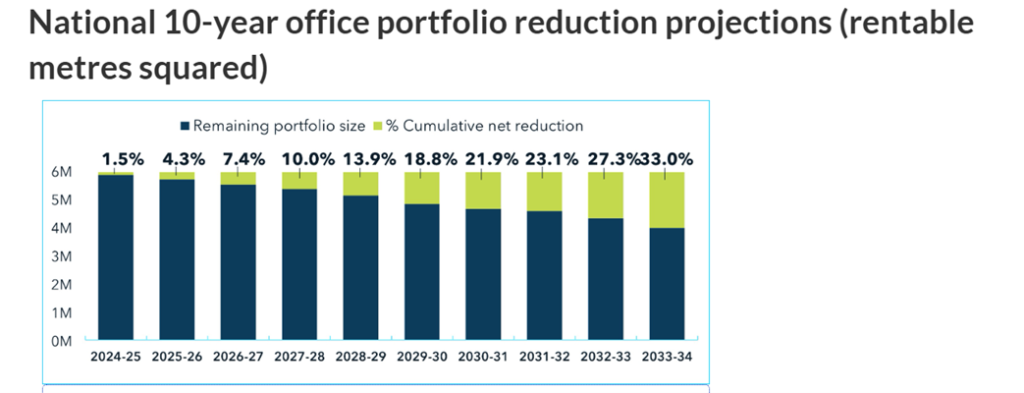
The PSPC track record on office space reduction includes:
- 2017: PSPC estimates that 50% of its office space is underutilized
- 2019-2020: PSPC makes plans to reduce office space
- 2020-2024: little office space reduction due to lack of funding
- 2024: Budget 2024 provides $1.1 billion over 10 years to reduce its office space by 50%
- 2025: PSPC finalizes it new office space reduction plan
Remember that in a previous iteration of PSPC initiative in cost savings for office accomodations, it was saving the federal government money through its new standard for office design – then Workplace 2.0 (2010’s) and now GC Workplace (2020’s). The implementation of Workplace 2.0 was a PSPC contribution to federal cost cutting as part of the Deficit Reduction Action Plan by the federal government in the early 2010s.
Everyone at the time focused on the first of the three pillars of a Workplace 2.0 environment.

The first pillar is the one with which we are most familiar. The third pillar is now standard post Covid-19, whereas it was aspirational when Workplace 2.0 was first implemented. The second pillar seems to need the most work.
The Auditor General reported on that workspace modernization implementation record in its 2025 report as follows:
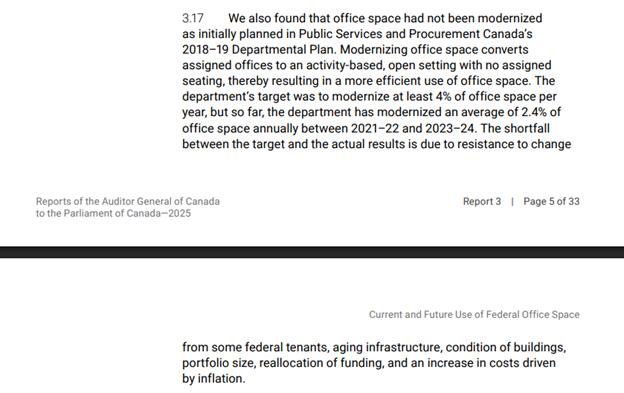
The gamechanger for GC Workplace was Covid-19. That plan to have 7 workstations for every 10 employees meant people would have to share desk space with strangers. That likelihood was greatly decreased by concerns about the potential spread of a pandemic. The “hotelling” aspect of no real assigned seating that GC Workplace would rely upon for savings seems to make a mockery of “return to work” to be with your team and co-workers. The intent of all those valuable person-to-person co-worker interactions will be lost if you are not seated anywhere close to them, let alone the same building.
Some of the contributing factors affecting the office workplace have changed post-Covid, where most now affect many of the core principles of GCWorkplace. Something has to give.

It is hard for PSPC to plan how much office space is required without complete and accurate input from its occupants. For example, three new initiatives of the federal government all require office space somewhere: the Defence Investment Agency; Build Canada Homes; and Canada Growth Fund. This accommodation must be sourced, built out, furnished and wired for agencies that are only now are in existence. This requirement must be carved out of their existing inventory of owned and leased office accommodations.
Don’t ignore the other stuff going
PSPC is doing some interesting things in the Parliamentary Precinct that may sneak up on those private-sector landlords trying to sort out their potential demand for office space.
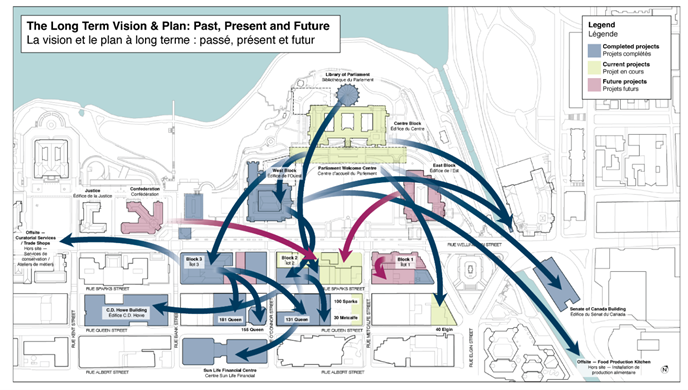
Renovations are underway at Terraces de La Chaudière (1.53 million SF) and Place du Portage (1.96 million SF) in Gatineau across the Ottawa River from Parliament Hill. PSPC purchased 181 Queen (0.265 million SF), 131 Queen Street (0.280 million SF) and 40 Elgin (0.190 million SF). The Block 2 redevelopment site on Welington Street will contribute 0.552 million SF. These buildings total 4.29 million SF.
That has PSPC taking 735,000 SF out of the private sector inventory with its acquisitions on Queen Street and Elgin Street.
The Government of Canada has addressed its carbon footprint by replacing its District Energy System with a P3 project of four energy centres interconnected by 14 km of underground piping. This P3 project has the Government much closer to achieving its carbon neutral target by 2030. It is easy to imagine that most of the federal government owned buildings in the Parliamentary Precinct will soon be using this low-carbon option.
In the illustration below the darker dots are office building the Government of Canada owns while the lighter dots are office space they lease.
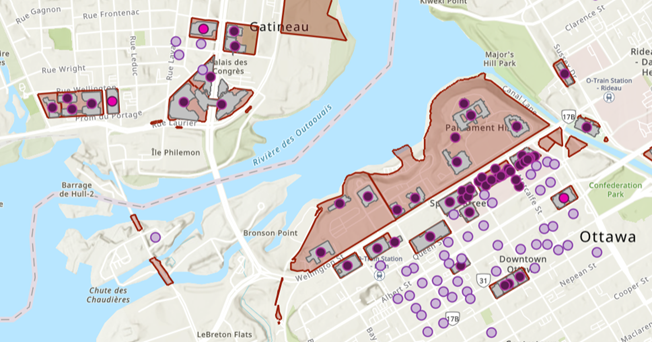
At the same time as PSPC has been renovating and/or buying buildings, some older office stock in Ottawa is being converted to residential rental units. These include:
- 473 Albert Street (139,000 SF) converted by InterRent and operational.
- 360 Laurier West (107,000 SF) converted by InterRent to 360 Laurier and operational.
- 200 Elgin (140,000 SF) converted by District Realty and operational.
- 110 O’Connor Street (200,000 SF) being demolished by Groupe Mach.
- 77 Metcalfe Street (126,000 SF) being demolished by Groupe Mach.
- 130 Slater Street (123,000 SF) bought by Katasa to convert to residential.
- 25 Nicholas (132,000 SF) bought by District Realty for residential conversion; and,
- Katasa at 66 Slater (258,000 SF) and a player to be named later at 275 Slater (195,000 SF) could be residential conversions.
Residential conversions are completed or proceeding for another 967,000 SF, with the final two examples representing another 453,000 SF of office space possibly eliminated from the CBD inventory. The Jackson Building (210,000 SF) could be one of the projects for affordable housing for which the City of Ottawa received $400 million in funding from the federal government.
Wait, is that the expanded LRT I see?
This will be operational in 2026:
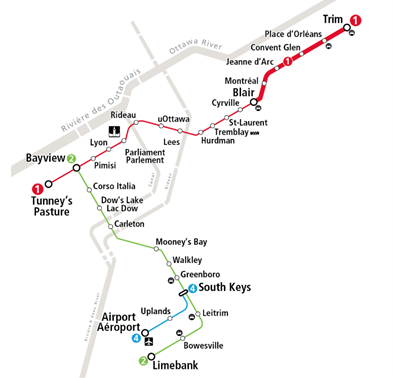
Line 1 already operates from Tunney’s Pasture to Blair. Line 2 already operates from Bayview (think LeBreton Flats) to south of the airport. The Line 1 East extension is completed and is running field tests. It will be operational in 2026.
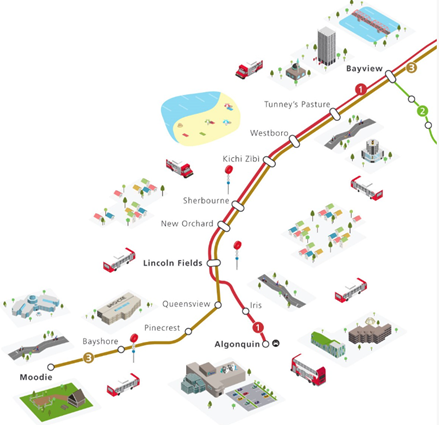
The West extension of Line 1 to Algonquin College and the new Line 3 out to DND HQ is due for completion 2027. All these transit benefits for the central business district (CBD) are finally about to appear. LRT Phase 1 seems to have made the commute from the suburbs to the CBD worse. These south, east and west extensions will hopefully improve public transit appeal.
But what does PSPC think are their objectives?
Ah, herein lies the lure to the trap for private-sector landlords. The private sector assumes that the federal government has the same goals for accommodations as do private-sector landlords for its existing stable of occupants. This may or may not be true. Fortunately, you can check to see how PSPC is making out in its annual Departmental Plan (DP) as to what it has achieved in the past fiscal year.
In the section dealing with Core responsibility 3: Property and Infrastructure it says:
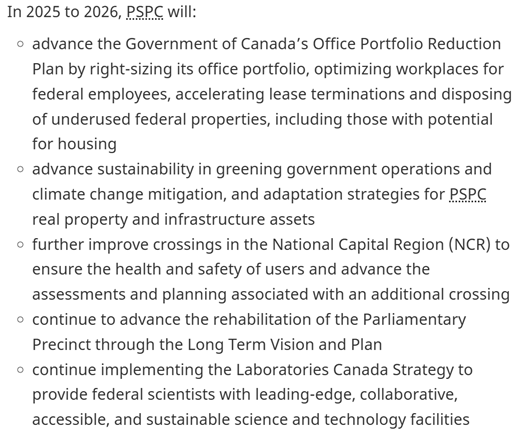
Charlie Munger (formerly vice chair of Berkshire Hathaway) has a mantra along the lines of “show me the incentive and I will show you the outcome”.
The following is a list of the of what actions were reported on (and presumably incentivised) in the 2024 to 2025 PSPC Departmental results report.
- Percentage of Crown-owned buildings that are in fair or better condition
- Percentage of Crown-owned heritage building that are in fair or better condition
- Percentage of PSPC-managed office space that is fit-up (modernized) each year to mee the current Government of Canada Workplace Fit-Up Standards known as the GCWorkplace approach
- Percentage of real property projects that are delivered within scope, on time and on budget
- Percentage of time that PSPC’s real property facilities are fully operational
- Operating expenses per square metre of Crown-owned office space
There are still the usual objectives as well:
- 600 m walking to an LRT or rapid transit stop
- 75/25 split in space between Ottawa and Gatineau (space or people)
- the greener the better
- 12 m to natural light
- It better be at least 5,000 square metres
And don’t forget about the federal government’s initiative to make government operations smaller. It has targeted 16,000 positions starting April 2026, extending through 2029 to return the size of the public service workforce to a more sustainable level as detailed in its November 2025 budget. Its target is a workforce of about 330,000, 40,000 less than its peak. Government departments are instructed to find 15% savings over three years.
It all adds up to:
It’s difficult to tell how PSPC is making out in disposing of the surplus properties. In part because they have a long gestation period between making the announcement that a property is deemed surplus, to making it available for disposition.
It’s about the same as always because, as the Auditor General found, PSPC does not make that much detail publicly available. Being an insider like the Auditor General does not mean they know any more about it.
Don’t ignore the other stuff going on as PSPC is close to having a number of long-term initiatives closer to completion. Whether it is a building they have been extensively retrofitting, new construction or buying buildings from the private sector, they do have other space to backfill. They have an operational district heating system that gets them that big leg up in meeting carbon neutral building operations. Keep in mind that several older office buildings in the CBD are being repurposed to residential or other non-office purposes. The LRT system is about to shine once the east and west extensions are complete and the service area with close proximity to a station increases dramatically. GCWorkplace will likely need a rethink as workstation sharing and hotelling may not be the future of mainstream office accommodation, but maybe the past.
And in a recent development, PSPC has announced they are rethinking the cuts to office space requirements.
What does all this mean for PSPC renewing or leasing space with you?
This is a checklist:
- be within a 600 m walk from rapid transit.
- be 5,000 m2 or more.
- be green – LEED, BOMA Best etc..
- meet their accommodations standards – accessibility, washrooms, natural light, etc..
- have a plan to get to carbon neutral.
- if you already have GCWorkplace buildout, you are likely good to go.
- if you don’t have GCWorkplace buildout, is it easier for them to relocate to new premises with the conversion completed, versus have those renovations around them.
- they prefer to be the only occupant of a tower or building as that makes security easier.
Plus ça change, plus c’est la même chose.